Wassily Kandinsky: Synesthesia & Abstraction
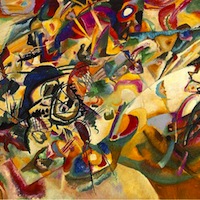 Long have I appreciated the obfuscation of reality brought forth in abstract art. As a kid, I was drawn to it. It’s careful, but it’s not too careful. The father of abstraction, Wassily Kandinsky, was a synesthete. He, like few before him and John Burke after him, sought to evoke sound through vision – pitch through color. His abstract paintings are pleasantly intricate and (perhaps literally) resounding. He was a pioneer, a teacher, a cellist, a painter – the quintessential artist. And, again, dear Wassily was a synesthete. Above-left is pictured his Composition VII, painted in Munich, Germany in 1913.
Kandinsky’s Synesthetic Experiences
Born in Moscow, Russia in 1866, Kandinsky grew up a boy fascinated by color. Eventually, he would liken the painting process to that of orchestrating a musical composition. He wrote:
Colour is the keyboard, the eyes are the harmonies, the soul is the piano with many strings. The artist is the hand that plays, touching one key or another, to cause vibrations in the soul.
Needless to say, Kandinsky also believed in the spirituality of artwork. It is something that he would write about in length in his 1910 book, Concerning the Spiritual in Art. While skeptics have long debated the legitimacy of Kandinsky’s synesthesia (much as the mere existence of synesthesia has been debated), it seems to have played an undeniable, integral role in his life and artwork. He once described his discovery of the phenomenon – something that occurred during an opera performance in Moscow:
I saw all my colours in spirit, before my eyes. Wild, almost crazy lines were sketched in front of me.
A young Wassily is said to have heard a peculiar hissing sound when mixing different colored paints in his childhood paintbox. From what I can gather, this man was indeed an authentic synesthete. He evidently had quite the imagination; this, however, was not a figment of unreality.
Read more about Kandinsky’s experiences.
The Qualities of a Color
It’s clear that this man saw more in color than the common man or woman. To him, color was more than a quality of an object, more than an adjective. Color had its own meaning, its own depth, its own purpose in our world. His description of his favorite color, blue, included “it calls man towards the infinite” – a spiritual reference, no doubt, but an honest perspective, I believe.
It’s difficult to put yourself in Kandinsky’s frame of mind. It’s neat to think about, though. Let’s give it a try. Think about your favorite color, be it Tomato red, Holly green, Sienna orange, Caribbean blue, etc. Beyond its appearance, or how it appears when manifested physically, what does it mean to you? What does it represent? What is its purpose?
If I get some good responses, I’ll chime in with my thoughts on black, which isn’t as much a color as it is a shade, but it’ll do. Don’t be shy, people. Synesthete or not, I’d love to get some abstract thinking going. Do it for Kandinsky!
Leave your comments below, and I’ll respond promptly. 🙂 Check out some more of Kandinsky’s artwork here.
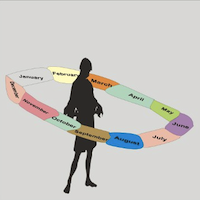 Do you visualize numerical sequences in physical space? How ’bout days of the week, months in the year, or years in the past decade? If Wednesday’s floating to your left, and 1999 is situated just above your head, you may be experiencing spatial sequence synesthesia. Since several readers have inquired about this form, I thought it appropriate for a post topic. As far as tests go, there isn’t a whole lot to discuss. This form is relatively self-explanatory. Perhaps some of you, though, who’ve had similar experiences, mightn’t have thought them to be synesthetic. Let’s dive a little deeper!
 One of the forms of synesthesia that I’ve always found to be particularly interesting and interestingly romantic is
  Have you ever talked to a friend or family member and realized that your brain activity is – to some degree – atypical? Don’t fret; you’re not alone. Whether your